Solana Liquid Staking Tax in Australia: Mark-to-Market vs CGT (2026)
The ATO has no specific guidance on mSOL, jitoSOL, jupSOL, or other LSTs. Two defensible approaches exist — CGT-only and income-on-accrual. Here's what each means, what records to keep, and how SolanaStake calculates daily mark-to-market rewards.
The gap: ATO has not specifically addressed LSTs
The Australian Taxation Office has clear guidance on native staking rewards — they're assessable income at the AUD value when received. But liquid staking tokens like mSOL, jitoSOL, bSOL, and jupSOL work differently: you don't receive a stream of new tokens. Your LST balance stays the same; what changes is the SOL it can be redeemed for. The token quietly appreciates against SOL over time as validator rewards accrue inside the protocol.
As of writing, the ATO has not published a specific ruling on this kind of yield mechanism. That leaves taxpayers and their accountants choosing between two defensible interpretations.
The two defensible views
1. CGT-only view (most common)
Swapping SOL for an LST is a CGT disposal of SOL. While you hold the LST, no income event occurs — the appreciation is unrealised. When you swap the LST back to SOL (or sell it), the gain or loss is realised: capital proceeds minus the cost base of the LST tokens you acquired.
This is the default treatment in Koinly and CryptoTaxCalculator, and aligns with the ATO's general framing of crypto tokens as CGT assets.
2. Income-on-accrual view (more conservative)
The exchange-rate appreciation is economically equivalent to staking yield. Each accrual point — practically, each day — is recognised as ordinary income at the AUD value of the SOL accrued that day. The cost base of the LST steps up accordingly, so disposal later only realises post-accrual movements.
This is the more conservative reading and produces higher near-term tax. It's defensible if the ATO ever decides the "substance over form" of LSTs is a yield instrument.
Both views are reasonable. The CGT-only view is simpler, defers tax, and matches what most retail tools do. The income view is what a conservative tax adviser might recommend for a client who wants to minimise audit risk if the ATO ever publishes hostile guidance. There is no objectively correct answer today.
Why this matters: a worked example
Suppose you deposit 100 SOL into Marinade in July 2025 and receive 90 mSOL (at the prevailing rate of ~1.11 SOL per mSOL). You hold for the full FY 2025-26. By June 2026, the rate has risen to 1.18 SOL per mSOL.
- CGT-only view: No income reported during FY 2025-26. When you eventually swap your 90 mSOL back to ~106 SOL, the gain over your AUD cost base is a CGT event in that future year (potentially with a 50% discount if held over 12 months).
- Income view: The rate moved from 1.11 to 1.18 — a gain of 0.07 SOL per mSOL. Multiplied by 90 mSOL = 6.3 SOL of accrued yield, taxed as ordinary income at the AUD value on the day each daily increment accrued.
Same economic position, very different tax outcomes for the year.
What records you should keep regardless
Whichever view you (or your accountant) take, the underlying data is the same. Keep:
- ✓Every deposit and withdrawal — date, SOL amount, LST amount, and the implicit exchange rate.
- ✓Daily LST/SOL exchange rate snapshots for the full holding period — needed for the income view, and useful for the CGT view to reconstruct cost basis if you partially exit.
- ✓SOL/USD and USD/AUD prices at each event date, for converting to AUD per ATO record-keeping rules.
- ✓Protocol fee disclosures for instant-unstake fees (Marinade ~0.3%) — these reduce realised SOL and are part of your cost basis under either view.
See your LSTs at a glance
Most crypto tax tools surface liquid staking tokens as opaque SPL token balances — you see "0.425 mSOL" without any hint of the SOL it represents or the yield it's accruing. SolanaStake breaks each LST out individually with its current SOL equivalent, so you can see at a glance what your liquid staking position actually looks like alongside your native staked SOL.
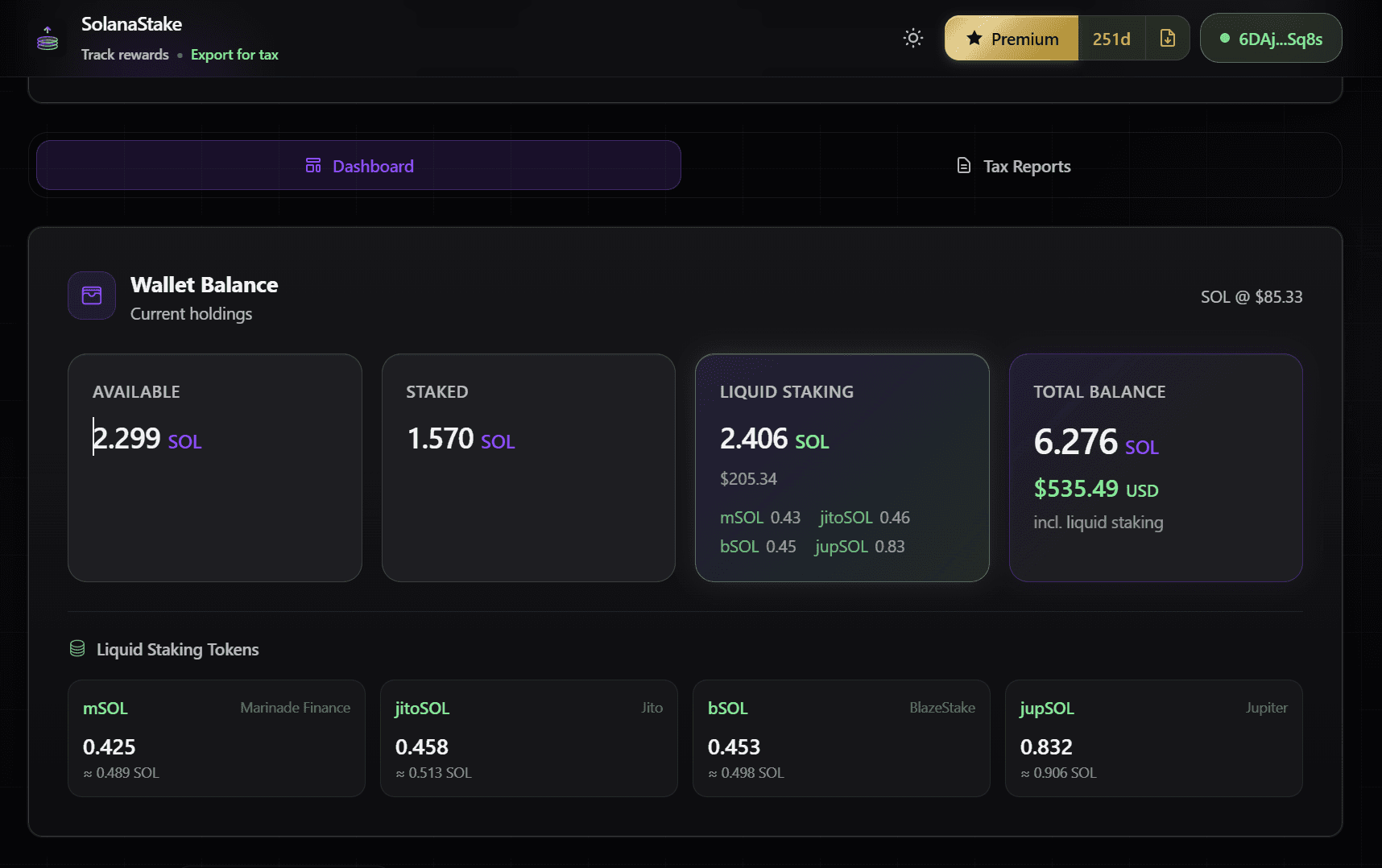
Available, staked, and liquid staking balances all roll up into the headline Total Balance — including the per-LST breakdown card.
How SolanaStake calculates LST rewards
For each (wallet, LST token) we run a daily mark-to-market calculation:
- Pull daily LST/SOL exchange rate snapshots from CoinGecko (we backfill 12 months on first sign-in and snapshot fresh rates every UTC midnight).
- Replay your on-chain deposit and withdrawal events to know your LST balance on every day.
- Per snapshot pair (typically 24 hours apart), compute
reward_sol = balance × (rate_end − rate_start). - On real protocol redemptions, emit a separate negative fee record so the running mark-to-market total reconciles to the SOL you actually receive.
This produces one row per day per LST position. Some rows are positive (rate went up). Some are negative (rate dipped — totally normal, even when the long-run trend is up). You see the totals broken out from native staking rewards in your tax export, with an LST tag on each row.
This is the data you (or your accountant) need for the income view. Under the CGT-only view, the daily rows are useful as portfolio analytics but you only file on disposal events. Both views are equally well-served by the same underlying record set.
Important: this is not tax advice
SolanaStake gives you the underlying numbers. Choosing between the CGT-only and income-on-accrual treatments is a judgment call that should be made with a qualified Australian tax professional who knows your circumstances. The ATO position may evolve, and what is defensible today may need to be revisited if a ruling is published.
If you're uncertain, the conservative path is the income-on-accrual treatment — it pays tax earlier but reduces audit risk under any future ATO interpretation.
See it for yourself
Connect your wallet, enable "Include liquid staking rewards" on the Tax Reports tab, and your CSV/PDF export will include both native staking distributions and daily mark-to-market LST rows with a clear Source column and an AU-specific disclaimer block.
Track My LST Rewards